This year’s shortlist highlights technologies that are not just supporting experiences, but actively redefining how they are built, operated, and felt.
Across the category are platforms and systems enabling personalisation at scale, real-time spatial interaction, AI-driven conversation, predictive optimisation, and mixed-reality deployment in live environments.
What connects them is a focus on applied innovation: technology used not as spectacle alone, but as infrastructure that expands creative possibility, improves operational performance, and opens new models for experience design.
Here are our shortlisted entries:
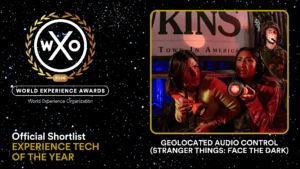 GEOLOCATED AUDIO CONTROL (STRANGER THINGS: FACE THE DARK) | Personalisation at Scale
Developed by Alterface for Stranger Things: Face the Dark at Netflix House Dallas (opened Q4 2025), this system enables real-time, location-based audio for large groups moving freely through the space.
Using indoor geolocation, each guest’s headset delivers audio triggered by proximity to scenes such as Castle Byers or Eddie Munson’s trailer.
The system supports hundreds of simultaneous users, dynamically synchronising when groups converge.
This solves a core LBE challenge: delivering personalised narrative without reducing throughput in a 60-minute, high-capacity IP experience.
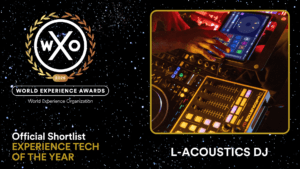 L-ACOUSTICS DJ | Real-Time Spatial Audio for Live Performance
L-Acoustics DJ enables real-time stem separation of stereo tracks into vocals, bass, drums, and instruments, allowing DJs to spatialise sound live.
The system has been deployed at Amsterdam Dance Event (The Other Side club), III Points Festival Miami, Beatport Live LA, and LIV Miami.
By removing the need for pre-authored object-based mixes, it lowers the barrier to spatial audio adoption in clubs and festivals.
It effectively converts stereo DJ workflows into spatial performance systems, expanding creative control across large-scale venues without additional production time.
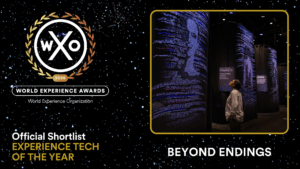 BEYOND ENDINGS | Conversational AI at Museum Scale
Developed for MOD. (Museum of Discovery, Adelaide) as part of the FOREVER exhibition, Beyond Endings uses Unreal Engine and Convai’s Character API to enable live, AI-driven conversations with digital characters.
Across 85,000 visitors, 87% of under-25s reported this as their first conversational AI interaction. Post-visit evaluation showed a 26% increase in confidence identifying ethical dilemmas.
The system has won the 2025 Good Design Award and 2026 Blooloop Award.
It demonstrates how AI can scale one-to-one interaction in public institutions without requiring additional staff.
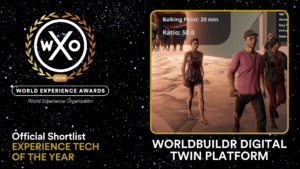 WORLDBUILDR DIGITAL TWIN PLATFORM | Predictive Design in Practice
Worldbuildr has been deployed across attractions, museums, and branded environments (including projects presented at WXO Summit and recognised at Blooloop Innovation Awards), using Unity-based digital twins to simulate guest behaviour before build.
Across implementations, it has delivered 15–32% increases in capacity, 22% reductions in wait times, and 12–18% lifts in per-cap spending.
The platform integrates live data from ticketing and POS systems post-opening, enabling continuous optimisation.
It moves experience design from static planning to a live, data-driven system with measurable financial outcomes.
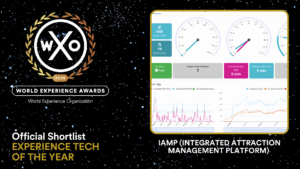 IAMP (INTEGRATED ATTRACTION MANAGEMENT PLATFORM) | Operating System for Parks
Developed by AliudQ, IAMP is deployed across large-scale attractions and parks (based on 25+ years of enterprise IT delivery), integrating queueing, capacity, ticketing, and infrastructure into a single system.
Features include virtual queuing, FastTrack monetisation, automated compliance reporting, and predictive simulation of park operations.
Operators using the platform report measurable increases in hourly throughput and per-cap spending through dynamic crowd steering and upsell integration.
It addresses a systemic issue in LBE: fragmented operational systems that limit both guest experience and revenue optimisation.
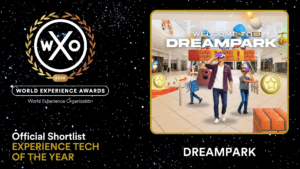 DREAMPARK | Mixed Reality in Real Environments
DreamPark has been deployed across 12 markets in four countries, transforming public parks, malls, and urban spaces into shared mixed-reality environments.
The platform uses all-terrain spatial mapping to anchor digital content in uncontrolled outdoor environments — a key limitation of most XR systems.
Experiences are accessible via both high-end MR headsets and mobile devices, allowing mixed user groups to participate simultaneously.
Recognition includes an AUREA Award and Webby nomination, validating its position as a scalable, location-based XR platform.
The WXO World Experience Awards 2026 take place on Tuesday 21 April at Ministry of Sound.
The ceremony marks the end of Day One of the World Experience Summit, a part of London Experience Week 2026.
Winners come decided by votes by members of the World Experience Organization – all leaders and practitioners shaping this industry – can vote. That is what gives these awards their unique weight.
Tickets are still available – click below for more.