

Hot topics! Useful provocations! No phones! Chatham House rules!
What happens in the WXO Business of Experience Room stays in the WXO Business of Experience Room. But the impact won’t stay there.
As you action the insights, tools, tactics and strategies you hear and debate in the WXO Business of Experience Room – they’ll show up in the quality and success of your work in the months and years to come.
A few facts to get us started:
- One room at London Experience Week will be dedicated to a series of roundtables, with a difference.
- It will run on Tuesday, Weds and Thurs of the Summit at Ministry of Sound.
- It’s called the WXO Business of Experience Room – no phones or fluff, straight to business and high-level, facilitated peer-to-peer discussion.
- Expert moderators to facilitate conversation.
- This isn’t ‘stars up on stage’ where you passively listen. Instead, this is interactive and democratic. The audience has the mic as much those at the table.
- We have 12 slots reserved for these roundtables. We’re open to your feedback to decide which topics to programme.
The roundtable is set out in a Samoan Circle design. Rather than ‘sage on the stage’, a glittering presentation and a few rushed questions at the end, the WXO Business of Experience Room is designed for conversation and connection, for debate and discussion.
The space is built around a central circular table, and the seats are arranged, roughly, in circles around. The moderator and a few selected experts sit at the table – but there’s room for more to join them. And the idea is that people share their POV, the conversation should flow around the room. Yes, there is also a screen for presenting – useful as provocation – but not the central focus of the discussion.
Don’t look at the screen, look at your fellow attendee.
The intent is to create a series of off-record, approach-oriented, detailed discussions about how to get experiences created, launched and run in a way that’s sustainable, profitable and successful.
So that’s the WXO Business of Experience Room. Sat somewhere near the centre of the global Experience Economy and with our ears always open, we believe we at the WXO have a reasonable view on the provocations and topics that’ll be useful.
But you may agree or disagree.
This is your chance to tell us what you think.
- Do you want to sit at the table?
- Do you think we’re asking the wrong questions?
- And do you want to ask and answer them?
There are 22 potential sessions to choose from – but only 12 spots. We’ll use your feedback to decide which ones make the cut.
Just email us at hello@worldxo.org using the subject line ‘WXO Business of Experience’ and tell us what you think, or if you’d like to lead or be at a table.
We’re currently curating key people to lead these sessions as moderators plus inviting named experts – so check back soon for updates.

Business of Experience: Potential Table Topics

From Swingers to Flight Club, Puttshack to the recently-opened Poolhouse, competitive socialising is one of the fastest-growing & most successful formats in the Experience Economy. It blends play, F&B, and repeatable revenue.
Venues often outperform traditional hospitality on:
- Dwell time (2–3x longer)
- Repeat visits (driven by gameplay + social loops)
- Higher per-head spend
- Lower reliance on constant new customer acquisition due to built-in replayability
Key Questions:
- So what are the secrets to competitive socializing’s success – and what can the rest of us learn from them?
- Why is competitive socialising outperforming traditional hospitality and leisure formats?
- What drives repeat visits? Is that design intentional? What are the best mechanics for repeat visitation?
- What can museums, brands, theme parks, LBEs, and even B2B events learn from these mechanics?
- How important is gameplay vs atmosphere vs social context?
- Considering the competitive socialising formats that haven’t worked – when does this model break? What doesn’t scale?
- Also, what about the competitive socializing startups that didn’t make it? What’s the difference between those that win vs those that close?
What You’ll Come Out Of This Business of Experience Room With:
Design and commercial principles transferable from one of the fastest-growing sectors to your work.

Traditional museums were built to preserve the past. New “museums” are built to sell tickets. As immersive, touring, and commercial experiences rise, the definition of a museum is being rewritten.
How can they preserve the past, enrich the present, and co-create the future?
Key Questions:
- When nuseums are attracting so much media attention and footfall, what can / should museums do to compete? (And do they need to?)
- What can museums learn from commercial, experience-led ‘nuseums’?
- What can ‘nuseums’ learn from institutions built on cultural authority?
- How can museums and nuseums play nicely together?
- AR vs artefacts: what should the balance look like, and does it matter?
- Touring vs permanent: which model wins, and when?
- Which is more important: the story or the objects?
- In an ever busier era, how does marketing of museums and nuseums need to change?
What You’ll Come Out Of This Business of Experience Room With:
Tools, tactics, strategies to design and market your historical experience better.
The experience world is moving fast. In the old world, experiences were seen as marketing. Understandable, given that activations drive 91% brand recall, 85% of consumers are more likely to purchase, and 98% create digital / social content at an activation.
But the new way flips that model: now experiences are the business.
Key Questions:
- Are you thinking about experiences as activations, when you should be thinking about them as assets instead?
- Is “positive-sum marketing” possible for your brand?
- Can your brand experience shift from a marketing cost to a revenue generator?
- What can we learn from Disney’s model – where experiences outperform the original IP?
- How are companies like Netflix and Minecraft evolving toward this model?
- What is the maturity curve from marketing activation to standalone business?
- When should IP serve experiences, and when should it be the other way around?
What You’ll Come Out Of This Business of Experience Room With:
A strategic lens for thinking about what experiences can do for your brand, and how you might turn your activations into revenue-generating assets.

The future for IRL IP experience isn’t pop-up or permanent – it’s both. The smartest players – like Diageo and Minecraft – are building flexible systems that deliver and capture value across all sorts of experiential formats, from touring LBEs to brand homes and theme park attractions.
Key Questions:
- How can you decide whether your IP should be a touring pop-up or permanent destination?
- How do you balance the agility of the pop-up with the scale of the permanent?
- What can we learn from models like:
- Minecraft (touring + theme park)
- Merlin × Fever partnerships
- How can you maximise lifetime value of IP across formats?
- What organisational structures enable both speed and scale?
- What should your experience portfolio look like?
What You’ll Come Out Of This Business of Experience Room With:
A strategic playbook for monetising IP across multiple experience formats.

Wellness and neuroaesthetic experiences are powerful – but so far, often small, niche, and hard to scale.
The opportunity to remake society is really exciting — but only if they can become commercially viable. Over to you…
Key Questions:
- Why don’t most wellness experiences scale today?
- What would it take to make wellness commercially viable at scale?
- How do you balance intimacy with growth?
- What role does neuroscience / neuroaesthetics play in design?
- Is “feeling better” a repeatable, monetisable experience – or just a nice to have?
What You’ll Come Out Of This Business of Experience Room With:
A path toward turning wellness into a scalable experience category.

Great experiences don’t automatically scale. Growth requires deliberate choices: replicate, adapt, reinvent.
Key Questions:
- What are the different models for scaling an experience? And which one is right for you?
- Scale in place vs duplicate vs globalise
- What should stay consistent – and what must localise?
- When does globalisation strengthen vs dilute the experience?
- What operational systems are required to scale successfully?
- What are the most common mistakes when expanding internationally?
What You’ll Come Out Of This Business of Experience Room With:
Growth playbooks for scaling experiences within and across markets.

Given the power of experiential marketing – 91% brand recall, 85% of consumers are more likely to purchase, 98% create digital / social content at an activation – sometimes it’s hard to understand why budget holders don’t release more budget to invest in experiences.
And yet… budget holders need more than just good vibes. The question “was it good?” just doesn’t cut it anymore. The question is “was it worth it?”
Key Questions:
- How to make ROI as clear as a crystal bell to increase the spend on brand activations / experiences?
- What metrics actually matter?
- Who is doing measurement well?
- How do you link experience to business outcomes?
- What experiences are most likely to deliver ROI?
- What should clients stop measuring?
What You’ll Come Out Of This Business of Experience Room With:
Tools to defend budgets. Strategies to move up the value chain, from marketing spend to capital expenditure. More / better measurement frameworks.
Have we now found the formats for profitable immersive experiences? Is the next challenge the distribution of that content through building out a network of black boxes that can host touring experiences, just as cinemas and theatres appeared to host cinema releases and travelling troupes?
If so, does that mean the end of innovation in the creative end of experiences? Do you agree: have we found formats for immersive work that work? And what are the emerging formats that point the way to a still more exciting future?
Key Questions:
- What are the key drivers of profitability in LBE?
- Touring vs permanent: which model is more sustainable – and when?
- How should IP influence your model choice?
- What utilisation rates, pricing, and throughput are required to succeed?
- Where do most LBE projects fail financially?
- What do the new distribution pipelines look like?
What You’ll Come Out Of This Business of Experience Room With:
A practical understanding of the commercial mechanics behind successful LBE, and what the future looks like for LBE around the world.

Bigger than film and music combined, the global gaming industry is a massive, rapidly growing market, valued at $300 billion in 2024 and projected to double to over $600 billion by 2030., And now this huge, exciting behemoth is making the first forays into IRL experiences.
There are two distinct angles to this conversation:
- How can IRL experiences borrow from (video) game mechanics to entertain, engage, increase dwell time and build fan bases that can’t help but play?
Clue: many already are, witness Phantom Peak, Lander 23, Bridge Command. - How should video game IP best show up in the real world and bring their players with them?
Clue: look at what Minecraft has done / is doing with Supply + Demand and Merlin.
But of course those are just a few examples, and there’s so many more insights, approaches to be shared, fought over, and figured out. Because bringing digital IP into physical space is difficult. And just because you understand the basic mechanics of a game, doesn’t mean you can translate that into an experience…
Key questions:
- What makes a real-world gaming experience worth leaving the screen for?
- Which formats are working (and why)?
- What do gaming audiences actually want offline?
- How do you monetise without breaking the community?
- Who is getting this right?
What You’ll Come Out Of This Business of Experience Room With:
Clear design principles and examples that work.

As client budgets tighten and attendee expectations rise, B2B events face more scrutiny than ever. The question is no longer “was it good?” but “was it worth it?”
Key Questions:
- What do the highest-performing B2B events actually deliver today?
- How are leading organisations measuring real outcomes vs vanity metrics?
- How do you connect experience design to pipeline, revenue, and retention?
- How do you justify spend internally in an environment of increasing scrutiny?
What You’ll Come Out Of This Business of Experience Room With:
A clearer framework for measuring, communicating, and defending the value of B2B experiences.

In the early 2010s, escape rooms were on the sort of growth curve that gets investors, rightly, excited. And then, the growth plateaued. Or did it…? With a leading panel of escape room specialists, we look at what happened to the rise, ‘fall’, and what the escape room pioneers did next. (Because they’re all around us, building some of the most immersive, amazing, successful experiences.)
But we think there are not only how to make experience learnings, there are also category learnings, and that it’ll help you figure out what you should do now, and what you’ll be doing in the future.
Key questions:
- What drove the initial growth of the escape room industry?
- Why did the industry stall?
- Which operators are still thriving?
- What are the pioneers doing now?
- What does this teach us about all experience formats?
- What does it suggest how each one of us should approach our work?
What You’ll Come Out Of this Business of Experience Room With:
A clearer understanding of the mechanics of escape rooms, and how they can inform the design of experiences today. The limits of new categories, and how to plan for them. A better ability to recognize the experience category you work in, and how that may evolve in the 2020s/2030s.

When the WXO’s founder first reported on experiential retail – in a ‘future of retail’ report for luxury carmaker BMW in 2007 – the key message was that with online retail rising, real world retail was going to have to be ‘more than a store’. That’s truer than ever today.
This exciting, emerging practice has plenty of promise, and pitfalls. We’ll examine these behind closed doors in the WXO’s Business Of Experience Room.
Key questions:
- What’s the right mix of experiences for a (retail) destination?
- What’s the purpose of the experiences – revenue, marketing, PR, or all of the above?
- Who’s responsible for the marketing?
- Do real estate partners invest in experiences enough?
- What do experience creators need to do to prove their worth to real estate partners?
- What do the economics look like – for both parties – in the short and long term?
What You’ll Come Out Of this Business of Experience Room With:
Sharper understanding of how experience-real estate deals are done, including insights on the economics, how the partnerships work, and the marketing.

Accessibility is often treated as compliance. A checklist. A cost. But the best experience creators are starting to treat it as a design unlock – one that improves experiences for everyone.
From audio design to spatial navigation, from neurodiversity to physical access, accessibility is no longer a niche consideration. It’s a creative frontier.
Key Questions:
- What does “accessible by design” actually look like in practice?
- Who is doing accessibility well, and what can we learn from them?
- How can accessibility improve the core experience, not just expand the audience?
- Where are we unintentionally excluding people, and why does that matter commercially?
- How do you design for neurodiversity, sensory sensitivity, and invisible disabilities?
- What are the most common mistakes teams make when trying to be accessible?
- How do you balance accessibility with creative intent?
What You’ll Come Out Of This Business of Experience Room With:
A clearer understanding of how accessibility can improve both the quality and reach of your experiences – and practical ways to embed it into your design process, your commercial design, and your marketing.
Sustainability is no longer optional. From travel emissions to temporary builds, from waste to energy use – experiences are under growing scrutiny from audiences, partners, and regulators.
Beyond compliance though, a bigger question: can sustainable experiences also be better experiences?
Key Questions:
- What does a genuinely sustainable experience look like – beyond surface-level gestures?
- Where are the biggest environmental costs in experiences today?
- Who’s leading the way? What are they doing differently?
- Can sustainability actually improve the guest experience?
- How do you balance sustainability with cost, scale, and ambition?
- What are clients and audiences starting to demand? How fast is that changing?
- What should we stop doing entirely?
What You’ll Come Out Of This Business of Experience Room With:
A realistic view of what sustainability means in practice – and how to design experiences that are both responsible and commercially viable.

One the one hand – music is one of the most powerful forms of experience design. It shapes emotion, controls attention, builds community. It drives repeat behaviour. And yet, most experience creators underuse and misunderstand sound.
On the other – the music industry is going through huge changes: the fall of clubbing, challenges for smaller venues, the rise and economic impact of mega residencies. Where does experience design fit in with the future of music?
This session brings together people from music, audio, and experience design to explore what happens when sound is treated not as decoration, but as core infrastructure. And how the broader idea of experience design is becoming ever more important to the music industry.
Key Questions:
- What can experience designers learn from how music creates emotion and memory?
- What can the music industry learn from the wider world of experience design – in terms of engaging and monetising the product?
- How do you design sound as part of the experience – not just an add-on?
- What are the best examples of sound-led experiences?
- How do live music formats translate into other experience categories?
- What role does sound play in dwell time, behaviour, and repeat visits?
- Where do most experiences get audio wrong?
- How is spatial audio changing what’s possible?
What You’ll Come Out Of This Business of Experience Room With:
Concrete tactics to use sound as a design tool, and practical ways to integrate it into your experiences.

From Shanghai to Riyadh, from London to Los Angeles – the Experience Economy is evolving fast. New formats, new funding models, new audiences. Jubensha in China, vibrations in Los Angeles
This session is a global intelligence exchange: what’s working, where, and why.
Key Questions:
- What are the most interesting experience formats emerging globally right now?
- Which regions are leading in what areas?
- Are there models/formats that only work locally? What’s set to scale internationally?
- What can we learn from tier 1 and tier 2 markets in China, South East Asia, the Middle East, and different cities across the US?
- Where are the biggest opportunities over the next 3–5 years?
- What trends are overhyped, what’s under the radar?
What You’ll Come Out Of This Business of Experience Room With:
Ideas you can use in your work. A clearer global picture of where the Experience Economy is heading, and if that will impact your work, locally or if you’re intending to scale internationally. You’ll also make useful global connections.

Luxury used to be about access: the best seat, the rarest object, the highest price point. But increasingly, the most valuable experiences aren’t bought, they’re earned. They require time, trust, taste, relationships, or participation. Status is shifting from what you can buy to what you can unlock.
For luxury brands and experience creators, this creates a challenge: how do you design something that feels exclusive, meaningful, and worth it — without making it easy, obvious, or transactional?
Key Questions:
- What do (U)HNW customers actually want from experiences now? How is that changing?
- What makes an experience feel “earned” rather than simply expensive?
- If the best experiences require effort, time, or discomfort, how far can you push that with luxury audiences?
- If experiences are better shared, where does privacy fit? When does exclusivity mean fewer people vs the right people?
- How are leading luxury brands and creators designing access?
- What are the best examples of luxury experiences today? What makes them work?
- How do you design for status and story, not just service and comfort?
What You’ll Come Out Of This Business of Experience Room With:
Practical ways to design experiences for luxury consumers that feel valuable, distinctive, and hard to replicate.

The most exciting experiences are often the hardest to sell. Because they don’t fit a known category, they can’t be easily explained. The very thing that makes them compelling – that is, their originality – makes them difficult to market.
From immersive theatre to new LBE formats, from experimental retail to entirely new categories, creators face the same challenge:
Key Questions:
- How do you build demand for something people don’t yet understand?
- How do you market an experience when there is no existing mental model for it?
- What do you lead with — story, format, IP, or outcome?
- How much should you explain vs leave unknown?
- What are the best examples of “hard-to-explain” experiences that sold well — and what did they do differently?
- How do you create trust and reduce perceived risk for audiences?
- What role do influencers, community, and word of mouth play in selling the unfamiliar?
- How do you avoid overpromising — or worse, misleading — when marketing something new?
- What should you not do when launching a new kind of experience?
What You’ll Come Out Of This Business of Experience Room With:
Practical approaches to positioning, messaging, and launching new experiences — and a clearer understanding of how to turn curiosity into conversion when you’re creating something genuinely original.

Any hotel can sell a room, and pressures on margins – from OTAs, costs, and competition – is only ever going to get more intense. As so many realise, the answer is to differentiate through the moments and memories that people have when they stay with you. From, in other words, the experiences people have.
But while the idea of experiential travel – transformative travel, even – is everywhere, it’s much harder to do than say.
So what does it actually take to deliver an experience people remember, tell their friends about, and come back for?
Key Questions:
- What does an experiential hotel look like in practice, not just in marketing?
- Who’s doing this well? What can we learn from them?
- How do you design experiences that drive both satisfaction and revenue?
- What role should F&B, programming, and partnerships play?
- How do you operationalise experience across teams and locations?
- Where does tech help? Where does it get in the way?
- When it comes to experiences, how can you balance consistency with uniqueness? How can you balance scale with memorability?
What You’ll Come Out Of This Business of Experience Room With:
A clearer view of what “experiential hospitality” actually means in practice – and how you can design, deliver, and scale experiences that guests value and deliver measurable value for your bottom line.

With so many sports, demand is not the issue. But the experience around the match – the before, during, and after – is often fragmented, frustrating, and under-designed.
Fans plan their day – even their week – around the game. But too often, the experience is limited interaction, queuing, poor F&B, little reason to stay.
Meanwhile, other sectors – from theme parks to social entertainment – are mastering dwell time, spend, and repeat engagement.
So the question isn’t how to fill stadiums. It’s how to design everything outside of the game.
Key Questions:
- What does a great end-to-end fan journey actually look like today?
- Who is doing this well? What are they doing differently?
- Where is the real value: the match itself, or everything around it?
- How do you design for the full day – before, during, and after the game?
- What can stadiums learn from theme parks, LBEs, and social entertainment formats?
- How do you increase dwell time and spend without damaging the core experience?
- What role should digital play?
- Who actually owns the fan experience – the club, the stadium, or third parties?
What You’ll Come Out Of This Business of Experience Room With:
A clearer understanding of how to design the entire fan journey – and practical ideas to turn high attendance into higher engagement, longer dwell time, and better commercial outcomes.
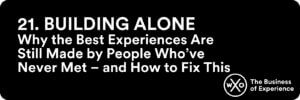
The experience industry talks a lot about collaboration. But too often, the people shaping the work are still operating in parallel.
Studios make the content. Designers build the worlds. Technologists engineer the moments. And brands fund it all.
The results can be incredible. But they’re often slower, more expensive, and more fragmented than they need to be.
Truth is, the ecosystem exists. But it’s not yet working as one.
What would it take to change that?
Key Questions:
- Where do the biggest breakdowns happen between studios, designers, technologists, and brands?
- Who is actually working well across these boundaries today? What are they doing differently?
- What does a high-functioning experience ecosystem look like in practice?
- At what point should each discipline enter the process? What happens when they’re brought in too late?
- How do you align creative ambition, technical feasibility, and commercial reality from the start?
- What structures, partnerships, or ways of working actually enable better collaboration?
- What should we stop doing because it consistently leads to poor outcomes?
What You’ll Come Out Of This Business of Experience Room With
Practical ways to collaborate more effectively across disciplines to create better, faster, and more commercially successful experiences.

When you bring many of the world’s leading experience pioneers together, new ideas and angles pop up.
So we’re going to leave a few sessions open at the Business of Experience Room in case something comes up that deserves more than a early morning chat over coffee on the way to an experience, or a 2-person late-night conversation at the bar.
Because the most important conversations aren’t – of course! – always the ones we plan in advance.
Here’s How It Works:
- People can propose topics at the event
- If they hit enough votes, we’ll run the event
- This will be facilitated, focused discussion (not chaos)
- Built around the same principles of openness, honesty, practical insight
Key Questions:
- What’s the challenge you’re facing that no one is talking about properly?
- What’s the issue in experiences that no one’s talking about, but should?
What You’ll Come Out Of This Business of Experience Room With:
Conversations that are urgent, relevant, and shaped by the people at London Experience Week.
Reminder: here at the WXO, we lead by listening. So feel free to email us at hello@worldxo.org with ‘WXO Business of Experience’ in the subject line and tell us what you think, or if you’d like to lead or be at a table.