This year’s shortlist brings together experiences that do more than impress the senses — they reshape how audiences think, feel, and participate.
Across the category are works that turn memory, grief, identity, science, fandom, and play into something spatial, social, and immediate, using technology, storytelling, and design with striking precision.
What connects them is their ability to make complex ideas tangible, creating experiences that audiences do not just witness, but actively process from the inside.
Here are our shortlisted entries:
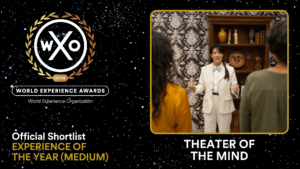 THEATER OF THE MIND
Groups of 16 move through a 15,000 sq ft installation where each room tests how your brain constructs reality.
In one space, you taste a “miracle berry” that turns sour sweet; in another, mirrors and lighting distort your sense of scale; elsewhere, VR sequences interrupt physical environments. An oversized kitchen, a dusty attic, and a pulsing disco are built as tactile sets, not screens.
The experience draws on research from institutions including UCL and MIT, but it never feels like a lecture. With 42,000 visitors in Denver and extended runs in Chicago, it proves that perception itself—memory, taste, attention—can be the subject and the material of an experience.
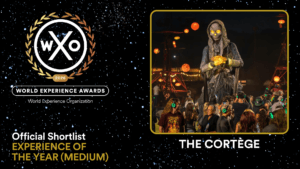 THE CORTÈGE
Over 10,000 people attended The Cortège during its six-week run in Los Angeles: a large-scale outdoor procession staged across a 200-foot field.
Audiences sat around the perimeter wearing wireless headphones, listening to a wordless cinematic score while drones, large-scale puppets, dancers, and robotic elements moved through the space. Before attending, guests could submit the name of someone they had lost; those names were read aloud in the only spoken moment.
At the end, the audience stood and joined the procession. The experience works because it uses structure—procession, rhythm, shared movement—to turn grief into something collective, legible, and physically felt.
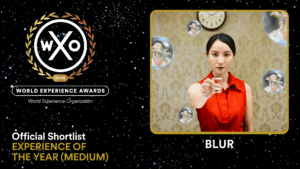 BLUR
BLUR
BLUR places up to 10 participants inside a shared XR environment where bodies, faces, and identities shift in real time.
Wearing headsets, participants move between solitary moments and group scenes, their digital forms reconstructed and animated live using human mesh capture and facial animation systems. A session lasts 45–60 minutes, during which people encounter each other as altered versions of themselves—part avatar, part human.
Presented at venues including the Venice Film Festival and PHI Centre, the experience achieves something specific: it uses technology not for spectacle, but to change how you perceive yourself in relation to others, moment by moment.
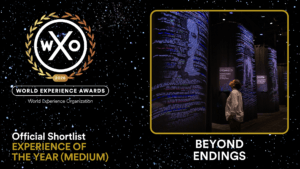 BEYOND ENDINGS
Visitors sit down for a job interview in the year 2125. The employer is Eterna.Life, a company offering forms of life extension: cryonics, consciousness uploading, cloning.
Three AI-driven characters—built in Unreal Engine and powered by real-time dialogue systems—ask questions, challenge answers, and adapt the conversation live. One might ask: who owns your uploaded mind? Another: who gets access to immortality? Across 85,000 visitors, 73% reported that ethical dilemmas felt more concrete after the experience.
What makes it work is the format: not a film, not a talk, but a conversation where your answers shape the encounter, forcing you to articulate your own position.
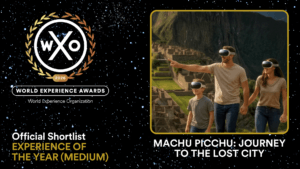 MACHU PICCHU: JOURNEY TO THE LOST CITY
Visitors walk freely through a large-scale VR reconstruction of Machu Picchu, built using LiDAR scans, drone imaging, and photogrammetry captured at millimetre precision.
Over 40 minutes, they move through temples, terraces, and mountain paths, witnessing events like a solar eclipse over the Andes. A voiced guide—TERI—adds narrative and orientation without dominating the experience. Shown across more than 10 cities, it consistently achieves ratings above 4.3/5.
The strength is clarity: instead of compressing history into screens, it gives people space to move through it, turning a remote, fragile site into something spatial, navigable, and memorable.
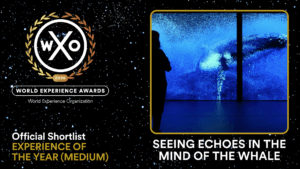 SEEING ECHOES IN THE MIND OF THE WHALE
This installation uses real whale recordings—captured by institutions like the Monterey Bay Aquarium Research Institute—to build a world where sound shapes what you see.
As visitors move through the space, whale vocalisations drive the visuals: clicks, calls, and pulses generate shifting forms, simulating how whales “see” through echolocation. The experience follows three species—bottlenose dolphin, humpback, sperm whale—each with a distinct sensory world.
Built using machine learning to isolate and classify sounds, and real-time rendering to translate them visually, it does something precise: it takes a non-human sense and makes it partially legible, without pretending to fully explain it.
 YOU:MATTER
Across seven rooms, visitors move from the Big Bang to the human body, encountering live environmental data, digital forests, and visualisations of breath and airflow.
In one space, your breathing alters the environment; in another, planetary systems respond to movement. The exhibition has drawn over 40,000 visitors and extended its run due to demand.
What makes it land is not the concept (“we are made of the same matter as the stars”) but the execution: datasets from NASA and environmental sources are translated into spaces you walk through, so the idea becomes physical—something you see change around you, not just something you’re told.
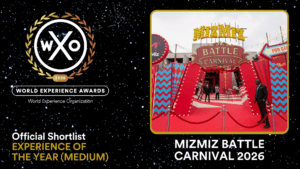 MIZMIZ BATTLE CARNIVAL 2026
Built to relaunch a gaming app, MizMiz created a full-scale retro carnival where every game mirrored a feature of the platform.
Guests entered through a neon-lit gateway, played claw machines and skill games tied to rewards and competition mechanics, and saw their scores update live on a central digital leaderboard. Cotton candy, popcorn, and branded prizes reinforced the theme, while live performances kept energy high.
The event reached 30M+ views on Instagram and 23M+ on TikTok. The reason it works is direct translation: instead of explaining the app, it lets people play it physically, turning abstract features into immediate, competitive experiences.
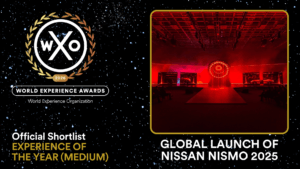 GLOBAL LAUNCH OF NISSAN NISMO 2025
The launch centred on a single visual device: a six-metre suspended red ring, glowing above the space.
Guests moved through a sequence beginning with a quiet, minimal tunnel inspired by Japanese craftsmanship, into a majlis-style gathering space, before the main reveal.
At the key moment, the ring pulsed and rose as three-sided screens split open to reveal two vehicles. Around it, installations included driving simulators, classic Nismo cars, and even a custom scent guests could take home.
The event generated 37.9M social reach and coverage across eight countries. What makes it effective is focus: one strong symbol—the ring—anchors everything else.
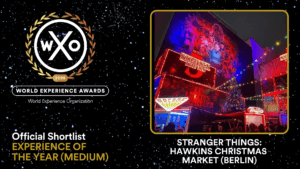 STRANGER THINGS: HAWKINS CHRISTMAS MARKET (BERLIN)
In Berlin, a traditional Christmas market was rebuilt as Hawkins, the fictional town from Stranger Things.
Visitors moved through stalls selling themed food, merchandise, and props from the show, while live performances and actors blurred the line between market and set. Over 150,000 people attended during the December run, with queues stretching for hours and branded mugs reselling online.
The experience works because it fuses two things people already understand—a German Christmas market and a global TV show—into a single environment, so participation feels natural: you don’t enter a “fan activation,” you enter a place.
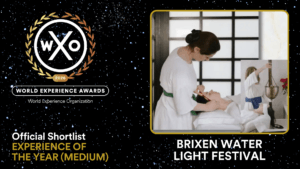 BRIXEN WATER LIGHT FESTIVAL
In a town of 23,000 people, the Brixen Water Light Festival drew 93,000 night-time visitors and over 14,000 daytime visitors to nearby sites.
The experience is a route: people walk through the historic centre encountering nearly 40 installations by 34 artists, where light, projection, and sound are embedded into buildings, rivers, and streets. Some works respond to movement; others invite interaction through simple inputs.
Themes include water scarcity, climate, and migration, but they are expressed visually rather than explained. The impact is not just artistic but economic: increased overnight stays in what is normally a quieter tourism period.
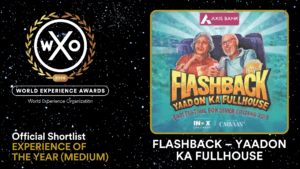 FLASHBACK – YAADON KA FULLHOUSE
Across 21 cities in 12 weeks, Axis Bank hosted 75 events designed for senior citizens, recreating the experience of watching films and music from earlier decades in a familiar, living-room-like setting.
Attendees didn’t just watch; they sang, shared memories, and participated in the programme. More than 16,200 people attended, and the campaign generated $4.77M in fixed deposits from a $16,000 spend.
The experience works because it is specific: instead of targeting a broad audience, it builds around a clear emotional trigger—nostalgia—and delivers it in a format that is comfortable, social, and easy to engage with.
The WXO World Experience Awards 2026 take place on Tuesday 21 April at Ministry of Sound.
The ceremony marks the end of Day One of the World Experience Summit, a part of London Experience Week 2026.
Winners come decided by votes by members of the World Experience Organization – all leaders and practitioners shaping this industry – can vote. That is what gives these awards their unique weight.
Tickets are still available – click below for more.