This year’s shortlist shows that smaller-scale experiences can deliver some of the deepest and most lasting impact.
Across the category are works that use intimacy, precision, and strong creative discipline to turn limited footprints into fully realised worlds — whether through one-to-one encounters, family spaces, transformative installations, or richly layered live performance.
What connects them is not size, but their ability to create experiences that feel personal, memorable, and far bigger than their physical scale.
Here are our shortlisted entries:
 THE DEATH OF RASPUTIN
Over 12 sold-out weeks on Governors Island, The Death of Rasputin turned the last days of imperial Russia into a live, navigable world.
More than 9,000 guests moved through candlelit rooms, danced in courtly rituals, hid contraband, and took part in occult ceremonies, with a 25% repeat-attendance rate showing the experience rewarded return visits.
What makes it work is not just atmosphere but design discipline: a multi-layered audience-flow system handled large numbers without breaking intimacy, while light, sound, and performer cues guided people invisibly through the palace.
The result is a show in which participation is not decoration but the engine of emotional investment.
 THE HUM
The HUM turns music into a full-body physical experience. Guests sit or recline in a single vibroacoustic chair fitted with 28 contact points that translate sound into waves across the body, making rhythm something you feel through back, limbs, and torso rather than simply hear.
In its first month of commercial operation in Las Vegas, it reached roughly 80% occupancy without paid marketing, and 64% of guests returned within 72 hours.
Reviews describe deep relaxation, emotional release, and a reset in mood after just five minutes.
What makes it significant is its precision: carefully calibrated frequency, duration, and sequencing turn a simple seat into a repeatable, scalable format for embodied immersion.
 SCADSTORY ATLANTA
SCADstory Atlanta takes a familiar format—a campus visit—and rebuilds it as a four-part immersive journey.
Visitors begin in a gallery where student work is activated through projection and animation, then move through a corridor of light into a 360-degree room where projection, custom fragrance, and surround sound peak together before a final convergence around the line, “This Is Your Place.”
Every technical layer is exact: projection is calibrated to laser-scanned room geometries, generative lighting appears to emerge from surfaces, and scent is released at specific narrative beats.
The experience has helped shift enrolment intent, with post-visit surveys showing more prospective students naming SCAD as their first choice.
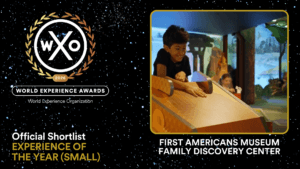 FIRST AMERICANS MUSEUM FAMILY DISCOVERY CENTER
At the First Americans Museum in Oklahoma City, the Family Discovery Center turns a two-storey, 5,000 sq ft space into a giant walk-in pop-up book.
Visitors enter a forest inhabited by “The Fab Six,” animal relatives drawn at up to 25 feet tall, while lighting and sound move the environment through day, night, and all four seasons in roughly an hour. Children play under a 30–40 ft canopy, follow scavenger hunts, and discover stories rooted in the 39 First American Nations in Oklahoma today.
Built on a modest $1m budget, it combines large-scale illustration, show control, AV integration, and cultural storytelling into a family experience that feels expansive, tactile, and specific.
 LENNOX MUTUAL
Lennox Mutual is theatre delivered through scheduled live phone calls. Each session lasts roughly 22–27 minutes and is performed by a human actor playing a representative of a fictional “life en-surance” company.
The medium is ordinary; the effect is not. More than 8,000 live calls have been delivered, around 800 participants have completed the experience, and some have continued for 100+ sessions at $20 per call. That level of repeat engagement points to something rare: a one-to-one experience that creates both intimacy and operational durability. By stripping away visuals, the show forces attention onto voice, pacing, silence, and imagination. The phone is not a gimmick. It is the fuel for the experience’s intensity.
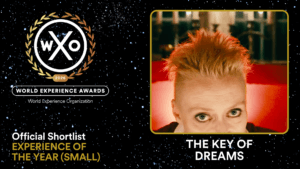 THE KEY OF DREAMS
The Key of Dreams unfolds over 24 hours inside a 17th-century manor house, where guests eat, drink, investigate, and sleep inside an ongoing fiction built from folklore, weird literature, and original storylines.
Fire-dancing, cocktails, handwritten notes, rapid set changes, and puzzle trails are woven into a format that gives guests genuine agency and then shows them the consequences.
Since opening in April 2024, it has drawn both new and returning audiences across multiple seasons, precisely because the experience evolves: characters change, investigations deepen, and previous actions continue to shape the world.
What makes it exceptional is the blend of hospitality, game design, and live performance into a format that sustains tension for a full day.
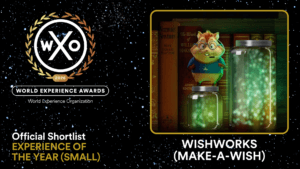 WISHWORKS (MAKE-A-WISH)
At the Finker-Frenkel Wish House in Miami, WishWorks reimagines the moment a critically ill child is asked to choose their wish.
Rather than relying on conversation alone, the experience uses scenic design, interactive media, and responsive storytelling to help children explore four pathways: to go, to have, to be, or to meet.
The child is not treated as a respondent but as the central participant in a guided act of imagination. Every element can be adapted in real time for age, mobility, or medical condition, and families move through the experience together.
What makes it powerful is its application of immersive design to care: it turns an overwhelming question into a structured, empowering journey.
 POLAR EXPERIENCE
Polar Experience Berlin is a climate exhibition built as a multisensory journey through ice, ocean, wildlife habitats, and future scenarios.
Visitors move through a 360-degree environment of large-scale projection mapping, reactive lighting, immersive sound, and interactive digital interfaces, while real-time climate data is translated into visual narratives that make scientific change visible and immediate.
Pre-opening studies showed a 38% increase in climate knowledge retention, 71% of visitors reporting greater motivation to adopt sustainable behaviours, and dwell time exceeding projections by 24%. The exhibition’s architecture is modular and reusable, with low-carbon materials and energy-efficient media systems.
What makes it work is that it turns climate information into something spatial, emotional, and physically graspable.
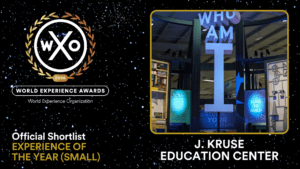 J. KRUSE EDUCATION CENTER
The Discovery Maze at the J. Kruse Education Center in Auburn, Indiana turns career discovery into a physical journey.
Instead of completing a questionnaire, students walk through a maze making live choices based on what energises them, what bores them, and what sparks curiosity.
Those choices map onto the RIASEC model—a widely used framework that groups interests into six types: Realistic, Investigative, Artistic, Social, Enterprising, and Conventional—quietly building a personalised profile as they move.
The experience sits inside Career Quest alongside hands-on pods in manufacturing, healthcare, agriculture, finance, and construction, with in-person coaching available afterwards.
In a system where 72% of recent US high-school graduates feel unprepared for life after school, it makes self-knowledge active, fast, and memorable.
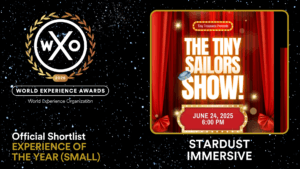 STARDUST IMMERSIVE
Stardust Immersive designs learning environments for children aged 0–6, especially 3–6, using classical music, dramatic play, sensory art, movement, and early science as a single system rather than separate activities.
In one session, children might explore light, water, sound, or space through role-play, gesture, rhythm, and hands-on making, with educators responding in real time rather than delivering fixed instruction.
The point is not theatre for its own sake; it is to build executive function, language, emotional intelligence, and problem-solving through experiences children can feel in their bodies. Families report stronger focus, confidence, communication, and creativity, while programmes run at capacity.
The achievement is not novelty. It is making immersive design do serious developmental work.
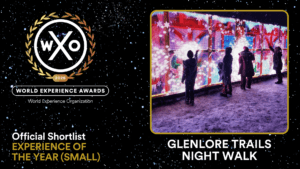 GLENLORE TRAILS – NIGHT WALK
At Glenlore Trails, Bluewater Technologies uses lighting, projection, sound, and interactive effects to turn a wooded trail into a sequence of story-led night scenes.
Guests walk at their own pace through illuminated clearings, projection moments, and soundscapes designed to make the forest feel authored rather than merely decorated. Optional magic wands unlock additional effects, adding guest agency without overcomplicating the route.
The format has delivered multiple sold-out dates and a 4.5/5 average rating, with guests describing it as “magical from start to finish” and “like stepping into a storybook.”
The reason it works is disciplined placement: spectacle is concentrated where it counts, so a real landscape does most of the emotional heavy lifting.
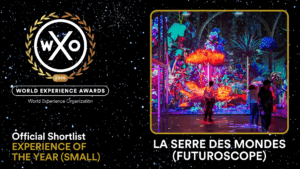 LA SERRE DES MONDES (FUTUROSCOPE)
At Futuroscope, La Serre des Mondes invites guests into a botanist’s workshop and then into a four-room storyworld of extraordinary plants.
Visitors are asked to observe, touch, smell, and listen as unusual species reveal themselves through projection mapping, lighting, sound, and interactive multimedia.
When the balance of the greenhouse is disrupted, the walkthrough shifts into a mission: the audience must help restore order. Moment Factory led the creative direction and technical design, integrating narrative, scenography, interactivity, and environmental cues into a single route.
The experience succeeds because it gives equal weight to curiosity and consequence: it begins like exploration and ends like stewardship.
The WXO World Experience Awards 2026 take place on Tuesday 21 April at Ministry of Sound.
The ceremony marks the end of Day One of the World Experience Summit, a part of London Experience Week 2026.
Winners come decided by votes by members of the World Experience Organization – all leaders and practitioners shaping this industry – can vote. That is what gives these awards their unique weight.
Tickets are still available – click below for more.